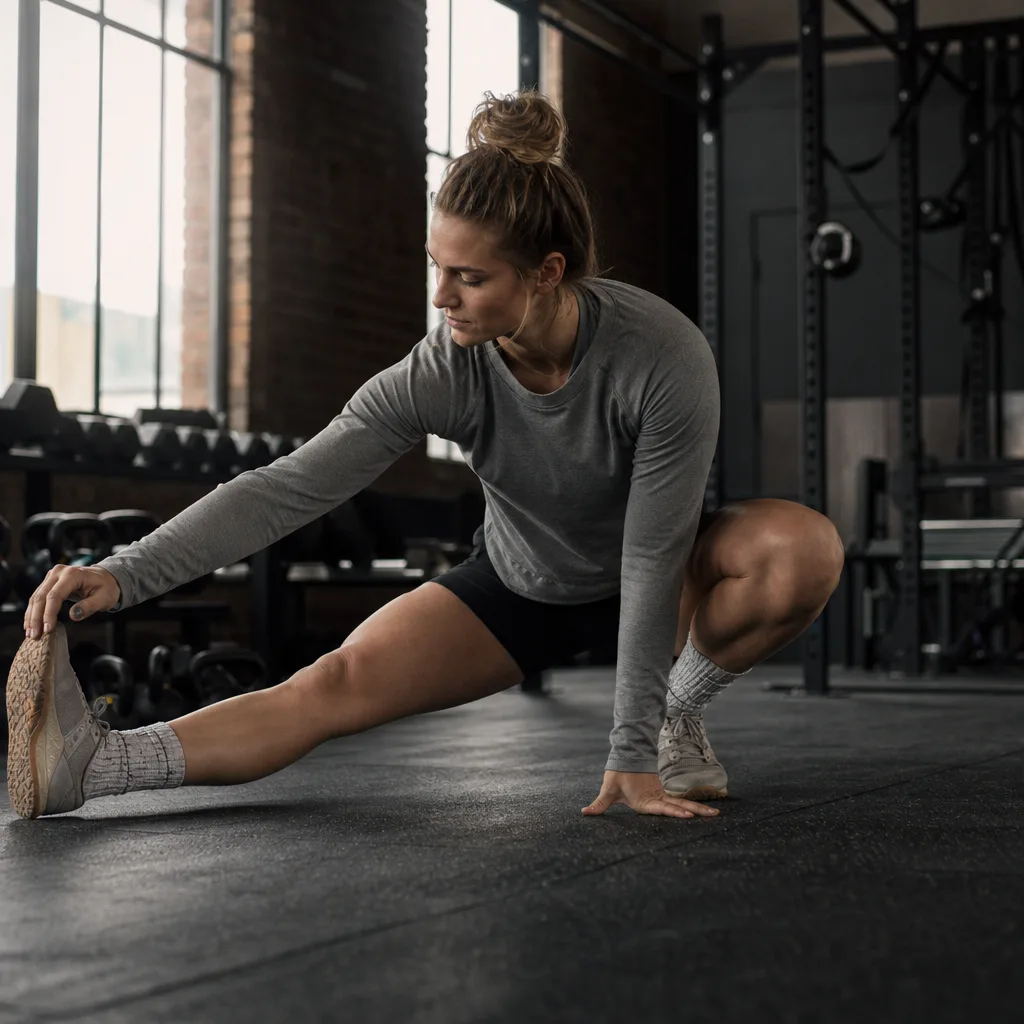
Skip the random stretching. These few positions unlock a deeper squat, a stronger overhead press, and fewer tweaks.
Mobility is the most misunderstood word in the gym. For most people it conjures an hour of aimless stretching that leaves them looser for twenty minutes and no better off by their next session. Real mobility is not passive flexibility; it is usable range of motion — the ability to get into a strong position under load and produce force there. Trained that way, it directly makes your big lifts better and your joints more durable.
Start at the ankles, because stiff ankles quietly wreck the squat. If your heels lift or your knees cannot travel forward, you compensate by folding at the hips or rounding the low back. A knee-to-wall drill — knee driving forward over the toes without the heel leaving the ground, a few sets of slow reps daily — restores the dorsiflexion a deep squat demands, and you will feel the difference in your very next session.
Move up to the hips, the engine of nearly every lower-body lift. The 90/90 position — both knees bent at right angles, one leg in front and one to the side, rotating between them under control — restores the internal and external rotation that lets you sit into a squat without your knees caving or your pelvis tucking. Add a few sets of deep goblet-squat holds, elbows gently pushing the knees out, and you are training range and strength at the same time, which is the whole point.
The thoracic spine and shoulders are where pressing strength lives or dies. If you cannot get your arms fully overhead without your ribs flaring and your lower back arching, the fault is usually a stiff upper back rather than tight shoulders. Open it up with thoracic rotations on all fours — one hand behind the head, rotating the elbow up toward the ceiling and back down — and prone or wall-supported overhead reaches. Better extension there means a stable, honest lockout instead of a compensated one.
The rule that makes all of this stick: train mobility with intent, not as a warm-down afterthought. Load the positions, spend time in the end ranges, and treat these drills as skill work you do most days rather than a stretch you rush through when you remember. Five focused minutes on the two or three positions your body actually needs will do more for your squat and press than an hour of scattered stretching ever will.